

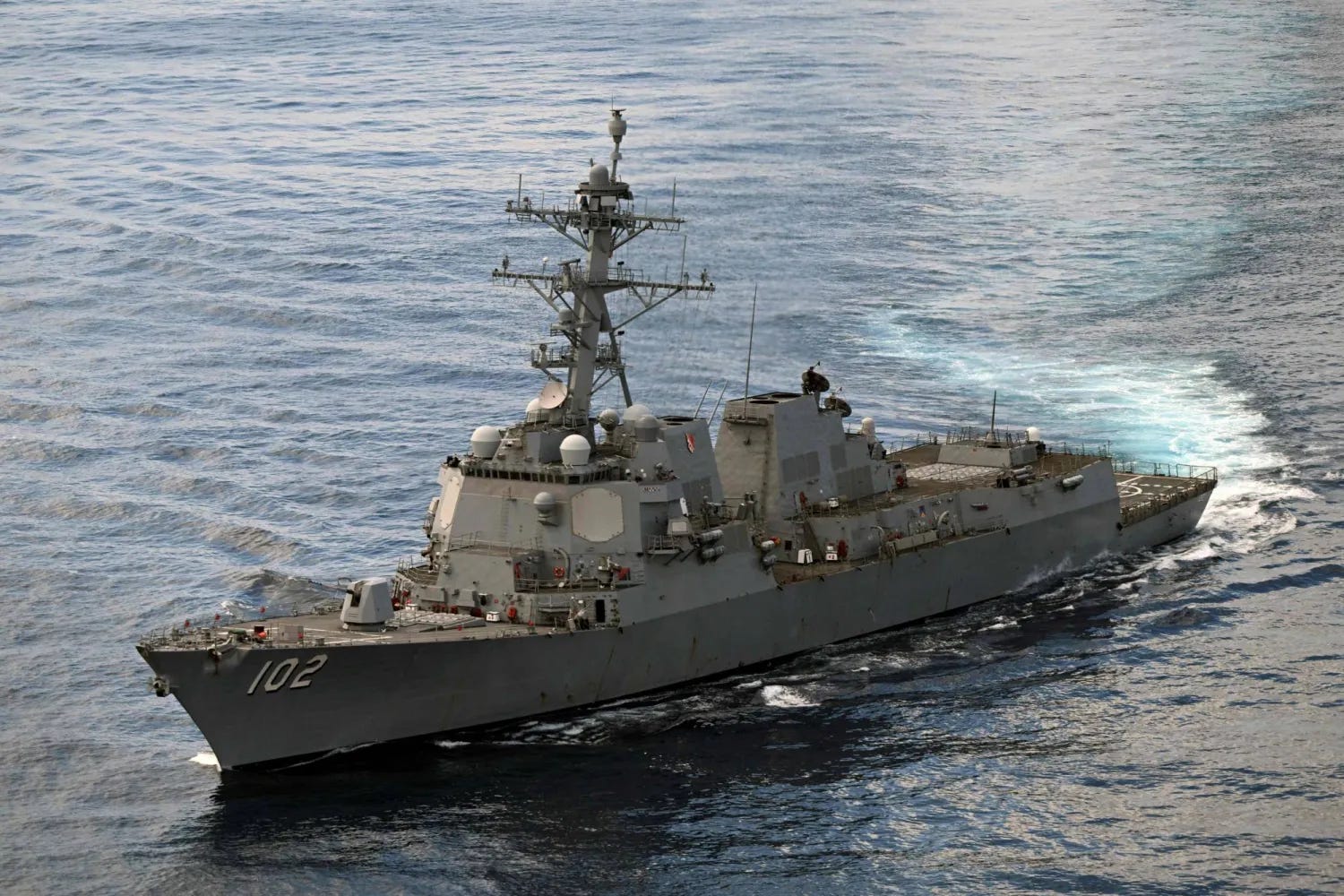
In recent weeks, the Trump administration has made two parallel moves that expose the brutal logic of US imperialism at home and abroad. In the US capital Washington DC, a city with a large Black population, Trump deployed militarized federal agents and National Guard troops to “fight crime”. Hundreds of kilometers to the south, the Pentagon directed a massive mobilization of warships and Marines toward the Caribbean Sea, with Venezuela as their stated target.
These are not isolated events. They are two sides of the same coin, part of a history of repression and domination by the United States government against people inside its own borders and beyond. The same authoritarian impulse that is seeking to crush dissent, control urban populations, and roll back civil rights gains in the United States is also driving the bellicose foreign policy that returns explicitly to the Monroe Doctrine in an effort to secure total control over natural resources and markets in Latin America.
The war at home: American troops in US cities
The latest front in the Trump administration’s assault on civil liberties is the outright militarization of policing in US cities. Following an executive order that directs federal resources to promote “aggressive policing,” the administration has taken a drastic step by federalizing the DC Metropolitan Police Department and deploying hundreds of federal agents from agencies like the FBI, DEA, and US Marshals Service. This move, which notably comes amid declining crime rate, is a clear abuse of power.
The justification for this unprecedented show of force is a fabricated “emergency.” As one analyst has argued, such a narrative is a smokescreen. The real purpose is to intimidate residents and create a blueprint for the expansion of authoritarian rule. The administration’s plans for a standing National Guard “quick reaction force” for civil disturbances have been condemned by retired Army Major General Randy Manner as “unneeded and dangerous.” “We should not be using the military against our own people in any capacity,” he stated.
This is not a new phenomenon. The militarization of police in the US has a long and sordid history, deeply intertwined with racial oppression. As far back as the 1960s, “white fear of Black insurgency” spurred legislation like the Omnibus Crime Control and Safe Streets Act, which funneled federal funds to local police to acquire military resources. Decades of the “War on Drugs” have disproportionately targeted Black and brown communities, turning police departments into occupying forces armed with military-grade equipment.
When Michael Brown was killed in Ferguson, Missouri, in 2014, the world watched as a local police department responded to protests with armored vehicles, sniper rifles, and tear gas leaving dozens wounded and hospitalized for critical conditions. The scenes were not from a war zone abroad, but from an American suburb where a community was demanding justice.
Similarly, during the George Floyd protests in 2020, as millions of youth mobilized, city streets across the nation were transformed into what then-acting Defense Secretary Mark Esper described as a “battlespace.” In Washington, DC, peaceful protesters were tear-gassed to clear a path for a photo opportunity for President Trump, who had just told the nation’s governors, “You have to dominate. If you don’t dominate, you’re wasting your time.”
This repression targets Black urban centers not just because of historical racism, but because these communities, with their strong working-class foundations, have consistently organized against US authoritarianism. From the anti-fascist work of the National Negro Congress in the 1930s to the Black Panther Party’s “United Front Against Fascism” in the 1960s, the Black community has long understood and pioneered an analysis that fascism is not just a European phenomenon but is native to the United States. They have been at the forefront of identifying and resisting it, from the legal terror of Jim Crow to police violence, understanding that these were forms of a “slow genocide”. The current wave of repression is a direct attack on these multiracial urban centers, where anti-Trump sentiment is strong and could lead to even larger demonstrations than in 2020.
For 100 years, Washington DC was a kind of fiefdom of the federal government, ruled by commissioners appointed by the president, with no elections for mayor or city council. The city’s residents, most of whom were Black after the Great Migration, were denied a voice in their own governance, a situation that amounted to the disenfranchisement of a predominantly Black population. The Civil Rights Movement was instrumental in forcing a change, leading to the Home Rule Act of 1973. This historic legislation allowed DC residents to elect their own mayor and city council. However, as it is still not a state, DC’s local laws and budget remain subject to Congressional review and ultimate control, and its residents have no voting representation in the US Congress. This unique legal status makes it an internal colony and grants the President additional powers that he cannot so easily exercise in a state. That’s why Trump is starting in Washington DC.
The war abroad: a new war on drugs in the Caribbean
The same militaristic mindset is on full display in the Trump administration’s foreign policy. Under the guise of a renewed “war on drugs,” the Pentagon has secretly been given the authority to use military force on foreign soil against Latin American “terrorist organizations”. This is a thinly veiled pretext for military intervention.
The most immediate target is Venezuela. As The New York Times reported, a secret directive signed by Trump approves the use of military force against drug cartels, with a particular focus on the “Cartel de los Soles,” an alleged shadowy network of military officers in Venezuela. This is a classic US playbook, using the “war on drugs” as a pretext for regime change. The US government has used the war on drugs as another way to advance its geopolitical designs in Latin America and justify the expansion of its military footprint.
The US has deployed a massive naval force to the Caribbean, including three amphibious assault ships, with more than 4,000 sailors and Marines along with P-8 spy planes and at least one nuclear submarine, intended to operate in proximity to Venezuela’s coasts. This is a serious show of force, the largest in years, and is a clear act of intimidation against the Venezuelan government of Nicolás Maduro. The threat of military intervention has been met with a strong response from the Venezuelan government, which has appealed to its people to enlist in the militia. For his part, President Maduro has consistently condemned the US aggression as a hostile act against Venezuela’s sovereignty, stating, “Venezuela is facing its greatest threat in 100 years. Having been defeated in all forms of hybrid warfare.”
The Trump administration’s threats are not limited to Venezuela. Mexican President Claudia Sheinbaum has had to publicly reject the possibility of a US military invasion, stating, “The United States is not going to come to Mexico with the military. We cooperate, we collaborate, but there will be no invasion—that is ruled out, absolutely ruled out.”
Connecting the dots: repression at home and abroad
The connection between these two policies is not a coincidence. It is the logical progression of an authoritarian regime that views its own population as a domestic enemy and other nations as obstacles to its global dominance. The Pentagon and the US political establishment see the streets of DC and the shores of Venezuela through the same lens of control and repression. The same tools of state violence—military-grade equipment, federalized forces, and a narrative of a manufactured “threat”—are being used on both fronts.
This connection offers a vital lesson. The struggle against police militarization in our own communities, which disproportionately targets Black people, is inseparable from the struggle against US military intervention abroad. Recognizing this link will be necessary to effectively challenge US imperialism abroad and the expansion of dictatorial methods at home.
 | A guest post by
|