

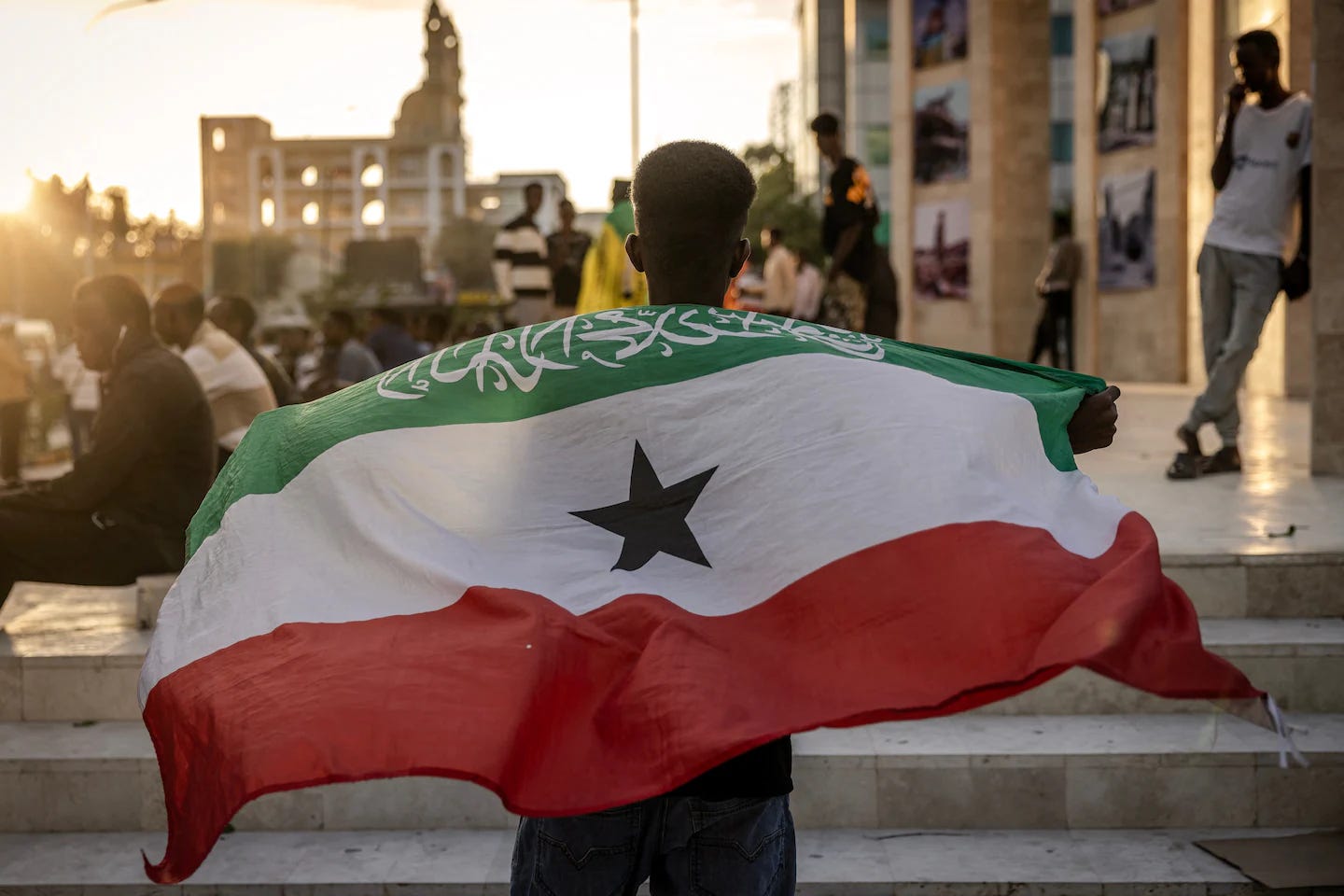
For a country so upset about recognition being afforded peoples under their thumb and control, the Israelis have decided to get into the state recognition business with festive aplomb. Africa’s Somaliland presented itself as a suitable candidate, an entity that remains part of Somalia but has asserted its own autonomy since 1991.
Israel’s recognition on 26 December of that entity had a vengeful sting to it. With a majority of UN Member States recognising the rubble and rump of a State of Palestine, despite arguments by the Netanyahu government that this was a reward for terrorism, the Israelis have clearly decided to turn the matter on its head.
Israel’s deputy ambassador to the United Nations, Jonathan Miller, captured the moment by saying that the recognition of Somaliland was not a “hostile step toward Somalia” when it evidently was, and did not “preclude future dialogue between the parties,” as well as it might. The salesman in Miller seemed to come through. “Recognition is not an act of defiance. It is an opportunity.”
Israeli Prime Minister Benjamin Netanyahu shamelessly plagiarised the lingo and language kit of those Member States of the UN who dared treat the Palestinians as a national group worthy of acknowledged sovereignty. In a call with Somaliland President Abdirhaman Mohamed Abdullahi on 26 December, Netanyahu stressed the importance of Somaliland’s “right to self-determination” in recognising it.
In a paper published in November 2025 by the Israeli-based Institute for National Security Studies, Asher Lubotzky recommended that Israel, along with its sympathisers in Washington, push the United States towards recognition. While falling short of endorsing the recognition gambit, the paper notes the value of the territory in terms of offering “an operational area” for Israeli military operations. Israel required allies in the Red Sea area for various reasons, “among them the possibility of a future campaign against the Houthis.” There were also economic and reputational issues for Israel to advance, “given the minerals located in Somaliland and Israel’s interest in cultivating relationships with Muslim populations in the region.”
The prattle about Somaliland’s sound credentials is evident in the world of think tanking. The Australian Strategic Policy Institute can be found making the point through a Somilander Australian, Abdi Daud, who writes of the territory as having “consistent peaceful democratic government over the past two decades.” While “imperfect,” this made Somaliland “a role model for the global south.” Recognising it would fill the “diplomatic and strategic vacuum” all too ripe for exploitation by Yemen’s Houthis, “terrorist organisations, China and other authoritarian regimes.” Daud evidently fails to appreciate that Somaliland’s recognition can just as well create a situation inspiring secessionist and separatist movements across the African continent.
Opposition to the recognition of Somaliland came in a stern joint statement by 21 Arab, Islamic and African nations made on 27 December 2025. The move would have “serious repercussions of such unprecedented measure on peace and security in the Horn of Africa, the Red Sea” and have “serious effects on international peace and security as a whole, which also reflects Israel’s full and blatant disregard for international law.” To recognise “parts of states constitutes a serious precedent and threatens international peace and security, and violates the cardinal principles of international law and the United Nations Charter.”
Looming darkly in the motives behind Israeli foreign policy was the possibility that something far more sinister was afoot. The joint statement finishes with “a full rejection between such measure and any attempts to forcibly expel the Palestinian people out of their land, which is unequivocally rejected in any form as a matter of principle.”
This was certainly the view of the Malaysian Prime Minister Anwar Ibrahim. Speaking at a special press conference held on 30 December 2025, Anwar declared that such actions would “violate international law and humanitarian principles, and would only perpetuate injustice rather than contribute to peace.” Using Somaliland “for the forced transfer of Palestinians is totally and wholly unacceptable.”
This concern is far from unreasonable: a number of news outlets reported in November that Israeli feelers had been put out to Somaliland on the possibility of relocating Palestinians. This chilling arrangement has many of the hallmarks of those debates from the 1930s on where Jews made stateless by Nazi Germany might eventually be sent.
The Somaliland Foreign Ministry is playing dumb on the issue of becoming a dumping ground for Palestinians, effectively turning into a client state for Israeli interests. In a statement, it rejected “the false claims by Somalia’s president about resettling Palestinians or establishing military bases in Somaliland.” The relationship with Israel was of a diplomatic nature and cognisant of international law. “These accusations,” the ministry huffed, “are designed to mislead the international community and undermine Somaliland’s diplomatic progress.” As if giving the game away, the diplomatic arm affirmed its commitment “to regional stability, and peaceful international cooperation.”
Support for Israel’s chess play by member states has been skimpy, though any worthwhile mention was bound to come from Washington. The United States, showing itself to be utterly muddled in its entanglement with its ally, decided to treat recognition as a parlour game show. Tammy Bruce, US deputy ambassador to the United Nations, summed up the cheap mood in her address during an emergency session of the UN Security Council: “Earlier this year, several countries, including members of this Council, made a unilateral decision to recognise a non-existent Palestinian state, and yet no emergency meeting was called to express this Council’s outrage.” The merits of international law, in the current cut and thrust of statecraft, remains increasingly in the jaundiced eyes of the beholder.
 | A guest post by
|